ETF Comparison Tool
Compare Two ETFs Side-by-Side
Don't just compare expense ratios - see how key factors impact your returns.
ETF 1:
ETF 2:
10-Year Investment Impact
Based on a $10,000 investment with 7% annual returns
Why comparing ETFs isn’t as simple as picking the cheapest one
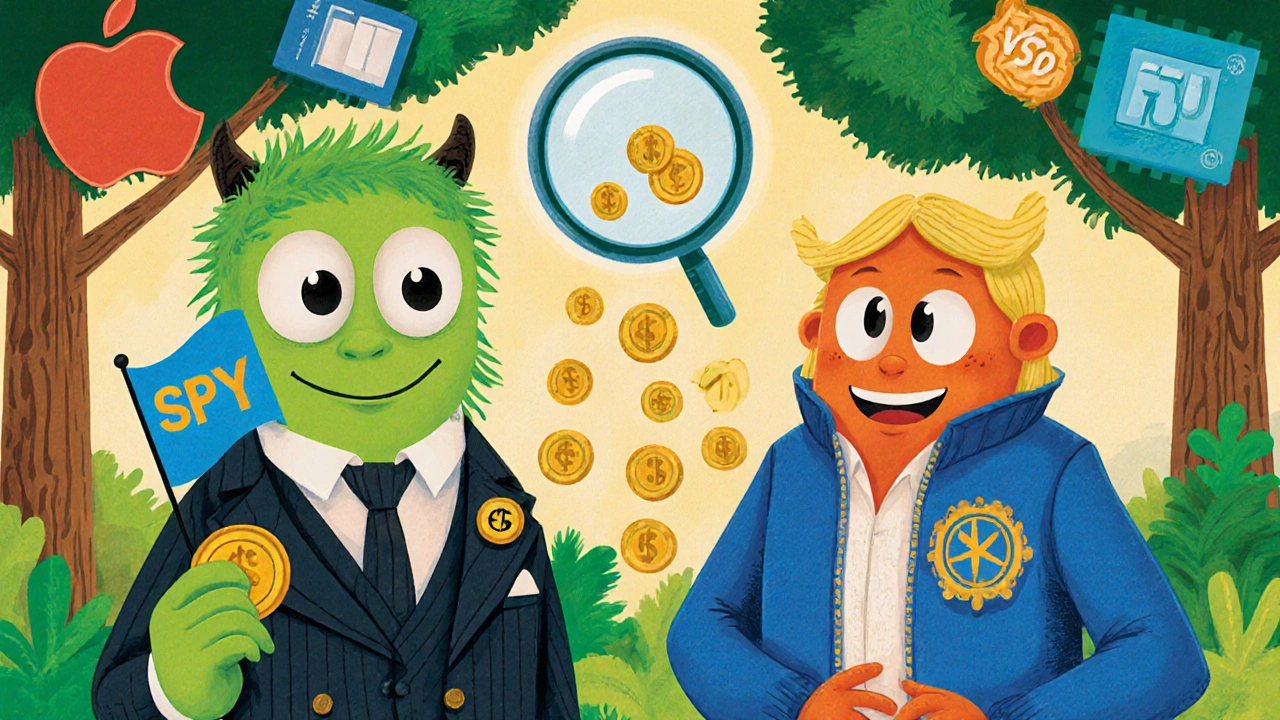
You see two ETFs with nearly identical names - say, SPY and VOO - both tracking the S&P 500. One charges 0.09%, the other 0.03%. It seems obvious which one to pick. But here’s the catch: the cheaper one isn’t always the better choice. In fact, some of the lowest-fee ETFs can cost you more in the long run because of hidden factors like tracking error, liquidity, or even how dividends are handled. The ETF market has exploded since 2020, with over 2,700 options in the U.S. alone. Many of them claim to do the same thing. But they don’t. And if you don’t know how to dig deeper, you could be leaving money on the table.
Look beyond the expense ratio - it’s just the start
The expense ratio is the annual fee you pay to own the ETF, expressed as a percentage of your investment. For broad-market ETFs like those tracking the S&P 500, fees have dropped to historic lows. The iShares Core S&P 500 ETF (IVV) charges just 0.03%. Vanguard’s VOO? Also 0.03%. But that’s not the full picture. Some ETFs, especially newer or niche ones, charge 0.50%, 0.80%, or even more. Those fees add up. A 0.50% fee on a $10,000 investment costs you $50 a year. Over 20 years, that’s over $1,000 in lost growth - assuming no compounding. But here’s what most people miss: expense ratios don’t tell you how well the ETF actually tracks its index. That’s called tracking difference. For example, one S&P 500 ETF might lag its index by 0.07% annually because of how it handles corporate actions or rebalancing. That’s like paying an extra 0.07% in fees, even if the official expense ratio is 0.03%. Morningstar’s data shows that in 2023, the worst-performing U.S. equity ETFs trailed their benchmarks by more than 0.50% - a massive gap for a supposedly passive product.
Holdings matter more than you think - even when the index is the same
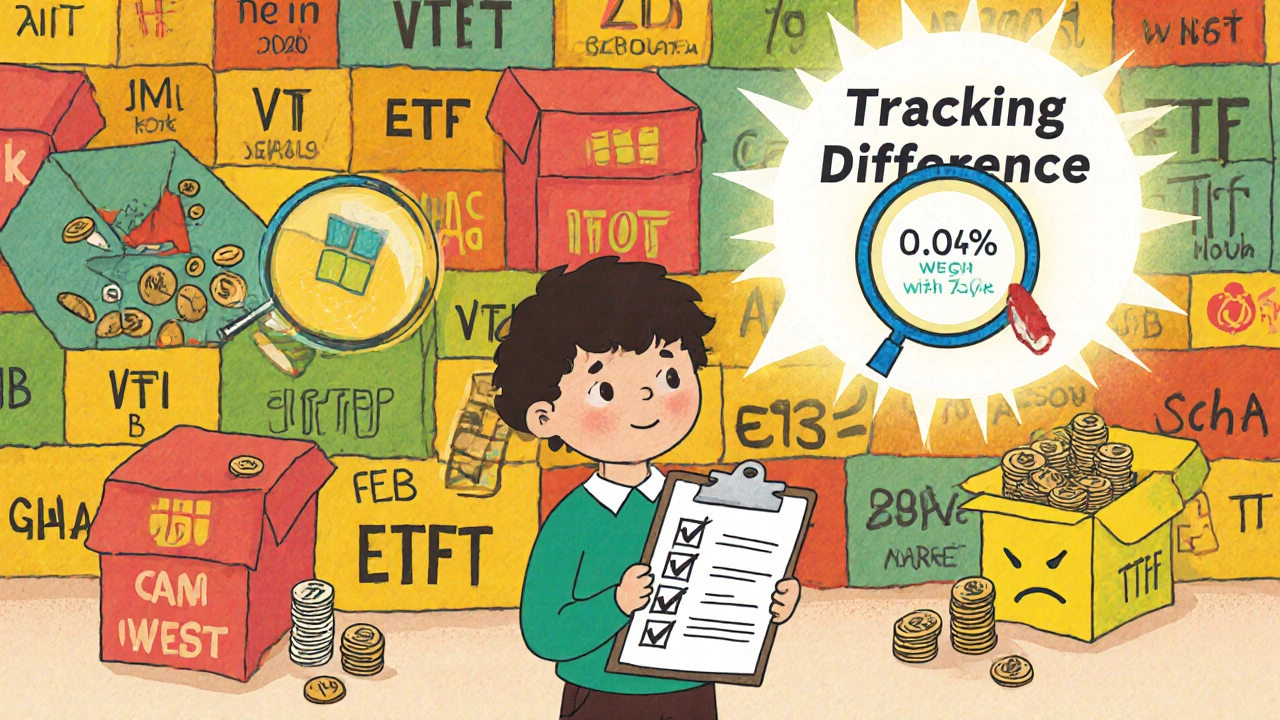
Two ETFs can track the same index and still hold completely different stocks. Take the Vanguard Total Stock Market ETF (VTI) and the iShares Core S&P Total U.S. Stock Market ETF (ITOT). Both promise exposure to the entire U.S. stock market. But VTI holds 3,499 stocks. ITOT holds 4,091. Why? Because they use different index providers with slightly different rules for what counts as a “total market” stock. The top 10 holdings look similar - Apple, Microsoft, NVIDIA - but their weights vary. Microsoft is 7.12% of VTI but 7.08% of ITOT. That 0.04% difference might seem tiny, but in a $1 million portfolio, that’s $400 in exposure you didn’t plan for. And it compounds. Then there’s sector exposure. One ETF might overweight technology by 1%, another might underweight it. That can shift your entire portfolio’s risk profile. Even ESG ETFs with similar names can have as little as 35% overlap in holdings, according to European regulators. One might exclude tobacco and firearms. Another might just avoid coal mining. You can’t assume similarity by name. You have to check the full holdings list.
Structure affects performance - and taxes
ETFs aren’t all built the same. There are three main structures: open-end funds, unit investment trusts (UITs), and grantor trusts. SPY is a UIT. That means it can’t lend out its holdings to generate extra income (like securities lending), and it can’t reinvest dividends automatically. Most newer ETFs, like VOO and IVV, are open-end funds. They can lend shares, which generates extra revenue that lowers your net expense ratio. That’s why VOO’s actual return sometimes beats its expense ratio suggests. The structure also impacts taxes. Open-end ETFs use an in-kind creation and redemption process. That means when big investors want to buy or sell large blocks, they swap shares for baskets of underlying stocks - not cash. This avoids triggering capital gains for the fund. As a result, ETFs distributed just $4.3 billion in capital gains in 2023. Mutual funds? They paid out $128.7 billion. That’s a huge tax advantage. But UITs like SPY don’t have the same flexibility. If you’re holding an ETF in a taxable account, structure matters. And if you’re buying a commodity or currency ETF, it’s likely a grantor trust - which means you get a K-1 tax form every year, not a 1099. That’s a hassle most investors don’t expect.
Liquidity and trading costs can eat into your returns
Just because an ETF has a low fee doesn’t mean it’s easy to trade. Bid-ask spreads - the difference between what buyers are willing to pay and what sellers want - can be wide on smaller or less liquid ETFs. For VOO or SPY, the spread is often less than a penny. For a niche ETF with only $50 million in assets? It could be 10 cents or more. That’s a 1% cost just to enter or exit. If you’re trading frequently, that adds up fast. Volume matters too. SPY trades over 40 million shares a day. A smaller ETF might trade 100,000. That means you might have to wait longer to get filled, or you might get a worse price. Fidelity’s data shows that even with identical expense ratios, the most liquid ETFs often deliver better net returns because of tighter spreads. And during market stress - like the 2020 crash or the 2022 rate hikes - spreads can widen dramatically. If you’re buying an ETF in a volatile market, check the average daily volume and the current bid-ask spread before you click buy.

Use the right tools - and know their limits
You don’t have to do this manually. Free tools like FINRA’s Fund Analyzer let you compare expense ratios and project costs over time. Vanguard’s ETF Comparison Tool shows you how much two ETFs overlap in holdings - a feature most platforms still don’t offer. ETF Database has a side-by-side comparison tool that lets you check up to four ETFs at once across 20+ metrics, including tracking difference, dividend yield, and turnover. But here’s the catch: these tools don’t always show you the full picture. For example, Morningstar’s ETF ratings evaluate five pillars: People, Process, Performance, Price, and Parent. A fund might have a low fee (Price) but a weak team managing it (People), or a flawed index methodology (Process). That’s not always visible in a simple comparison table. And for actively managed ETFs - which now make up 28% of new launches - you can’t rely on daily holdings. Many don’t disclose their full portfolio until quarterly. You’ll need to dig into SEC filings (N-PORT reports) on EDGAR to see what’s really inside. Don’t trust the “top 10 holdings” section on your brokerage app. That’s marketing, not analysis.
Real investor mistakes - and how to avoid them
Reddit’s r/personalfinance community is full of stories about ETF missteps. One investor picked a small-cap ETF based on the lowest fee - VB at 0.05%. But it had $157 billion in assets. Another option, SCHA at 0.06%, had only $32 billion. The user didn’t realize the smaller fund had a tracking difference of 0.15% - meaning it underperformed its index by that much every year. Over five years, that cost him over $750 on a $10,000 investment. Another investor chose an ESG ETF because it had “sustainable” in the name and a 0.10% fee. Turns out, 75% of its holdings were identical to a standard S&P 500 fund. The “ESG” label was mostly marketing. A 2024 survey found that 42% of retail investors pick ETFs based on lowest fees alone. That’s like buying a car because it’s the cheapest - without checking the engine, tires, or safety ratings. The fix? Make a checklist: 1) Expense ratio, 2) Tracking difference (find it on Morningstar or ETF.com), 3) Holdings overlap (use Vanguard’s tool), 4) Liquidity (check average daily volume), 5) Structure (is it a UIT or open-end fund?), 6) Dividend treatment (qualified or not?). Spend 20 minutes on each ETF you’re considering. It’s worth it.
What’s changing in 2025 - and what you need to watch
The ETF landscape is shifting fast. BlackRock plans to make daily holdings reports standard for all its index ETFs by mid-2025. That’s a big deal - right now, only a handful of ETFs do that. The SEC is also pushing for more transparency in active ETFs. And new types of ETFs are popping up: cryptocurrency, AI-focused, even ones tied to climate indices. The 10 Bitcoin spot ETFs launched in January 2024 have fees ranging from 0.20% to 0.95%. Same asset. Totally different costs. And smart beta ETFs - which promise to outperform by using factors like value or momentum - are failing more often than not. Research Affiliates found that 73% of these funds don’t deliver their promised factor exposure. Why? Implementation differences. One fund might use market cap weighting. Another might use equal weighting. Same name. Different results. The bottom line: the tools you used last year might not be enough this year. Stay updated. Check your ETFs at least once a year. And don’t fall for the myth that “all S&P 500 ETFs are the same.” They’re not.


It's wild how people treat ETFs like they're interchangeable soda flavors. You got your Pepsi (VOO), your Coke (SPY), your store-brand knockoff (SCHA) - but the real difference isn't the label, it's the chemical composition. Tracking error is the silent tax nobody talks about. That 0.07% lag? That's not noise - that's structural decay in your compounding engine. And don't even get me started on dividend treatment. Qualified vs. non-qualified isn't just a footnote - it's a 15% swing in your after-tax yield. ETFs aren't passive. They're engineered products with hidden friction. If you're not reading the prospectus like it's a contract for your financial future, you're just gambling with a spreadsheet.
LMAO. So you’re telling me I need to cross-reference 6 different metrics across 3 platforms just to pick between two S&P 500 ETFs that both have the same damn name? And you call this investing? This isn’t finance - it’s a fucking labyrinth designed by Wall Street to make retail investors feel dumb so they keep paying advisors. I mean, sure, VOO beats SPY by 0.02% because it can lend shares - but who cares? You’re not gonna notice it until you’ve got $5M. I just buy the one with the prettier chart on my app and call it a day. If your portfolio needs a flowchart to function, you’ve already lost.
Thanks for this. 😊 I used to pick ETFs by fee alone - now I check holdings on Vanguard’s tool and look at avg volume. Small change, big difference. I learned the hard way with a ‘low-cost’ emerging markets ETF that had 0.3% tracking error… lost $200 in 1 year. Now I take 20 mins. Worth it. 🙏