Call Option Profit Calculator
Option Details
Break-even Point
$203.00
Max Loss
$3.00
You need the stock price to reach $203.00 to start making a profit.
Profit/Loss Analysis
As time passes, the option's value decreases due to time decay. The chart shows how time impacts your position.
Key Insights
Time decay: In the last 30 days, about one-third of the time value disappears. In the last week, half of the remaining value is lost.
Volatility impact: If volatility drops after your purchase, your option value can decrease even if the stock price stays the same.
Strategy tip: Only buy calls when you're confident the stock can reach your break-even price before expiration.
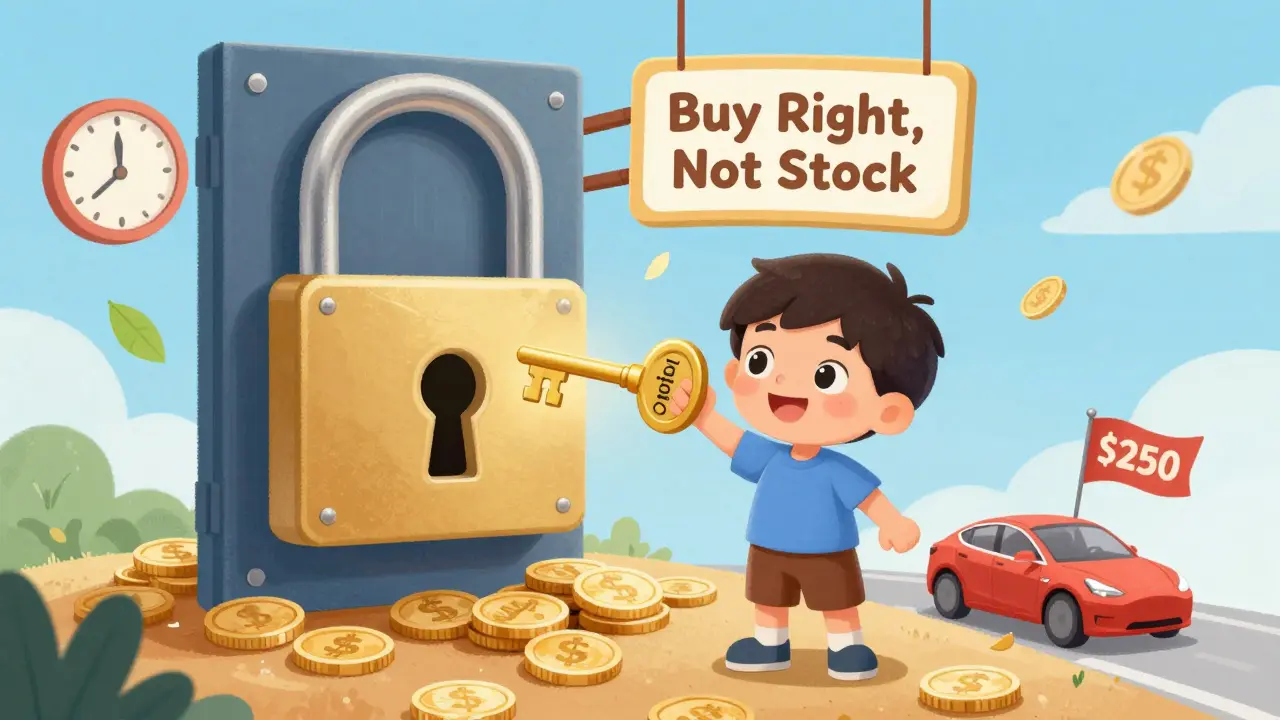
Buying a call option isn’t about owning stock. It’s about buying a right-the right to buy stock at a set price before a certain date. You don’t have to buy it. You just get to decide if it makes sense when the time comes. That’s the whole point.
Let’s say you think Tesla’s stock will jump from $200 to $250 in the next two months. Instead of spending $20,000 to buy 100 shares, you could pay $300 for a call option with a $200 strike price. If Tesla hits $250, you exercise the option, buy the shares at $200, and immediately sell them for $250. That’s $5,000 in profit minus your $300 premium. Net gain: $4,700. That’s a 1,566% return on your $300. On the stock itself? Only a 25% gain. That’s leverage.
But here’s the catch: if Tesla stays at $200 or drops to $180? You lose your $300. That’s it. No more. No margin calls. No chasing losses. Your risk is locked in from day one. That’s the beauty of call options. You know exactly how much you can lose before you even buy the contract.
What Exactly Are You Buying?
A call option is a contract. Standardized. Traded on exchanges like the CBOE and NASDAQ. Each contract covers 100 shares of the underlying stock. You’re not buying stock-you’re buying the right to buy 100 shares at a fixed price (the strike price) anytime before the expiration date.
Strike prices aren’t random. They’re set in steps: $1 apart for cheap stocks, $5 or $10 apart for expensive ones like Amazon or Nvidia. Expiration dates? Most are on the third Friday of each month. But now you’ve got weekly options and even LEAPS-those can last up to three years.
Price? That’s called the premium. It’s not the price of the stock. It’s the cost of the right. A $3 premium means $300 total for one contract (100 shares × $3). That $3 isn’t just about the stock price. It’s made of two parts:
- Intrinsic value: The difference between the stock price and the strike price. If the stock is $210 and your strike is $200, you have $10 of intrinsic value.
- Extrinsic value: Everything else-time left, market volatility, investor expectations. This part disappears as expiration nears.
Break-even? Simple. Strike price + premium. If you paid $4.50 for a $100 strike, you need the stock to hit $104.50 just to break even. Anything below? You lose. Anything above? You start making money.
Why People Use Call Options
People buy calls for three main reasons: speculation, hedging, and income.
Speculation is the most common. You believe a stock is about to spike. Maybe earnings are coming. Maybe a product launch. You don’t want to tie up $20,000 in cash. So you spend $500 on a call. If the stock surges, you win big. If it doesn’t? You lose $500. Still better than losing $20,000.
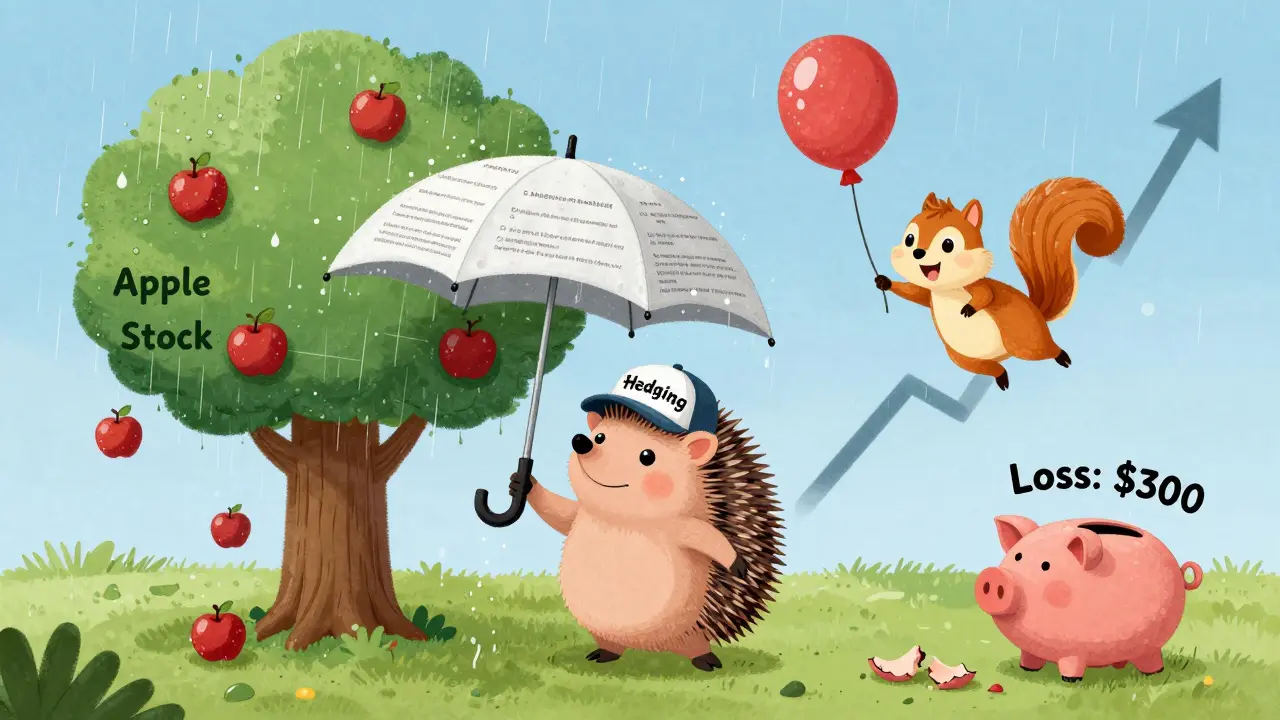
Hedging is quieter but smarter. You own 100 shares of Apple at $180. You’re worried about a short-term dip. Instead of selling, you buy a $175 strike call. If Apple drops to $160, you can still buy more shares at $175 to lower your average cost. If it goes up? You still keep your original shares and your call gains. You’re protected without giving up upside.
Income generation is trickier. Some traders sell calls to collect premiums. But buying calls? That’s not about income. That’s about betting on growth.
Call Options vs. Buying Stock
Let’s compare. You want to bet on Apple.
Buying stock: $188 per share. 100 shares = $18,800. If it goes to $200? You make $1,200. That’s 6.4%.
Buying a call: $2.69 premium. One contract = $269. Same $200 stock price? You exercise, buy at $188, sell at $200. $12 profit per share × 100 = $1,200. Minus $269 premium = $931 profit. That’s a 346% return.
Same move. Different risk. Same reward potential. But the call option needs the stock to move faster. Why? Because of time decay.
The Hidden Enemy: Time Decay
Options lose value every day. Not because the stock moves. Just because time is running out. This is called theta. And it accelerates.
Think of it like a coupon. A 30-day coupon for $10 off a $100 item is worth almost $10. A 1-day coupon? Maybe $1. Why? Because there’s barely any time left to use it. Same with options.
One-third of the time value vanishes in the last 30 days. In the last week? Half of what’s left. If you hold a call through expiration and the stock hasn’t crossed the strike price? Poof. Your premium is gone. No second chances.
This is why most retail traders lose. They buy cheap, far-out-of-the-money calls with months left, then sit and wait. The stock barely moves. Time kills the option. They get frustrated. They think they’re bad at trading. They’re not. They just didn’t understand time decay.
Volatility Matters More Than You Think
Implied volatility is the market’s guess at how wild the stock will be. High volatility? Options cost more. Low volatility? Cheaper.
Why? Because if a stock is expected to swing wildly, the chance it hits your strike price goes up. So the premium rises. If volatility drops after you buy? Your option loses value-even if the stock price stays the same. That’s vega.
Example: You buy a call on NVIDIA at $400 strike. Premium is $15. Volatility is 50%. Then earnings come. The stock barely moves. But volatility crashes to 30%. Your option might drop to $8 even though the stock is still $400. You didn’t lose on the stock price. You lost on the market’s fear level.
That’s why you can’t just pick a stock you like. You have to ask: Is volatility high now? Is it likely to drop? If yes, avoid buying calls right before earnings unless you’re prepared to lose.
Who Wins and Who Loses
Call options aren’t a magic money machine. They’re a tool. Like a hammer. Use it right, you build something. Use it wrong, you smash your thumb.
Winners:
- People who understand time decay and buy options with enough time to play (at least 45-60 days out).
- People who buy in-the-money or at-the-money calls (strike close to current price) when volatility is low.
- People who use them to hedge, not to gamble.
Losers:
- People who buy deep out-of-the-money calls (e.g., $500 strike on a $200 stock) hoping for a 10x return. The odds are 95%+ against them.
- People who hold until expiration without a plan.
- People who don’t know their break-even point.
FINRA says only 28.7% of retail traders who trade options make consistent profits over three years. That’s not because options are risky. It’s because most people treat them like lottery tickets.

How to Start-Without Losing Everything
You don’t need $25,000 to buy calls. But you do need discipline.
Step 1: Paper trade for 60 days. Use your broker’s simulation tool. Buy calls. Watch them expire. Learn how time and volatility eat into your position. Don’t skip this.
Step 2: Limit your exposure. Never risk more than 5-10% of your total portfolio on options. If you have $50,000 invested, don’t put more than $5,000 into calls.
Step 3: Know your break-even. Write it down before you click buy. Strike price + premium. If the stock doesn’t hit that? You’re losing.
Step 4: Use stop-losses. Set a 20-30% loss limit on your option position. If it drops that much, get out. Don’t wait for it to hit zero.
Step 5: Avoid 0DTE options. Zero days to expiration? Those are for professionals with algorithms. You’re not one. Don’t play.
What You Need to Know Before You Trade
Brokers won’t let you trade options until you pass a quiz. That’s not a formality. It’s a lifeline.
You need to understand:
- The Greeks: Delta (how much the option moves with the stock), Gamma (how delta changes), Theta (time decay), Vega (volatility sensitivity).
- Volatility cones: Is current volatility high or low compared to history?
- Probability of profit: Most brokers show this. If it’s below 30%, think twice.
It sounds complex. But you don’t need to be a mathematician. You just need to know the rules:
- More time = more room to breathe.
- Higher volatility = higher cost.
- Never buy a call unless you’re sure the stock can hit your break-even before expiration.
TD Bank says it best: A call option is the right to buy a stock at a set price before a set date. That’s it. No magic. No secrets. Just math and timing.
Final Thought: It’s Not About Being Right
Most people think options trading is about predicting the future. It’s not. It’s about managing risk and timing.
You don’t need to know if Tesla will hit $300. You just need to know if it can hit $205 in 45 days-and if the premium you paid makes that possible.
Call options give you power. But power without control is dangerous. Use them to amplify your best ideas-not to chase dreams you can’t afford to lose.
What happens if I don’t sell or exercise my call option before expiration?
If your call option is in the money (stock price above strike price), most brokers will automatically exercise it for you. You’ll buy the shares at the strike price. If it’s out of the money, it expires worthless and you lose the premium you paid. Always check your broker’s policy-some require you to manually exercise.
Can I lose more than my premium on a call option?
No. Your maximum loss is always the premium you paid. That’s the biggest advantage of buying calls over selling them or trading futures. You can’t get margin-called. You can’t owe money. Your risk is capped.
How do I calculate the break-even point for a call option?
Add the strike price and the premium you paid. For example, if you bought a $100 strike call for $4.50, your break-even is $104.50. The stock must reach that price before expiration for you to start making a profit.
Are call options better than buying stock directly?
It depends. If you’re confident in a short-term move and want to control risk, calls give you leverage and limited downside. But if you believe in a company long-term, buying stock is simpler and avoids time decay. Calls are tools for timing. Stock is for holding.
Why do so many people lose money trading call options?
Most buy cheap, far-out-of-the-money options hoping for a miracle move. They ignore time decay and volatility. They hold too long. They don’t know their break-even. They treat options like gambling. The math is against them. Smart traders use calls to reduce risk, not increase it.
What’s the best time to buy a call option?
When implied volatility is low and you expect a price surge soon. Avoid buying right before earnings or major news events-volatility spikes, premiums get expensive, and if the move doesn’t happen, you lose twice: on the stock and on the premium. Look for calm before the storm.
Do I need a special account to trade call options?
Yes. Most brokers require you to complete an options trading application and pass a quiz about risks and mechanics. You’ll be assigned a level (usually Level 1 for buying calls). You don’t need $25,000 unless you’re doing day trading. Just basic approval is enough to buy calls.

It's remarkable how many retail traders conflate leverage with wisdom. A call option is not a lottery ticket-it's a derivative instrument governed by stochastic calculus and the Black-Scholes model. The notion that one can 'win big' by gambling on out-of-the-money contracts reveals a fundamental misunderstanding of probability distributions. The premium isn't a fee; it's the market's pricing of implied volatility, time decay, and risk neutrality. If you're not modeling delta-gamma-theta-vega in real time, you're not trading-you're speculating with your retirement fund.
Oh wow, look who’s got a PhD in finance from YouTube. You think you’re so smart because you know what theta is? Meanwhile, I bought a $200 strike on Tesla for $1.50 last month-stock went to $210 in three weeks and I turned $150 into $3,000. You’re the guy who reads the manual while everyone else is driving. The market doesn’t care about your Greeks. It cares about momentum. And guess what? Momentum doesn’t care about you either. But it pays the people who act-not the ones who overthink.
There is something profoundly human, isn’t there, about the way we seek to control uncertainty through financial instruments? We buy options-not merely as contracts, but as talismans against chaos. We imagine, if only we can price the future correctly, we can outrun entropy. And yet-the market, indifferent, erodes our premiums with each passing second. Theta, that quiet assassin, does not judge. It simply is. We are the ones who assign meaning-to the strike, to the expiry, to the break-even. We are the ones who hope. And perhaps, in that hope, we find not profit-but purpose.
i think the fed is secretly manipulating option prices to keep us poor. they want us to think its about 'volatility' and 'theta' but really its all a psyop. i bought a call on apple and it went down even though the stock went up. coincidence? i think not. check the cme data. they're hiding something.