Every time you run an ad, post a customer review, or show an APR on your website, you’re playing with fire-if you don’t know the rules. In 2025, the line between persuasive marketing and illegal deception is thinner than ever. The FTC, SEC, CFPB, and state regulators are watching. And they’re not just sending warnings-they’re handing out fines that can crush small businesses and rewrite the balance sheets of big ones.
Claims Must Be Truthful, Not Just Creative
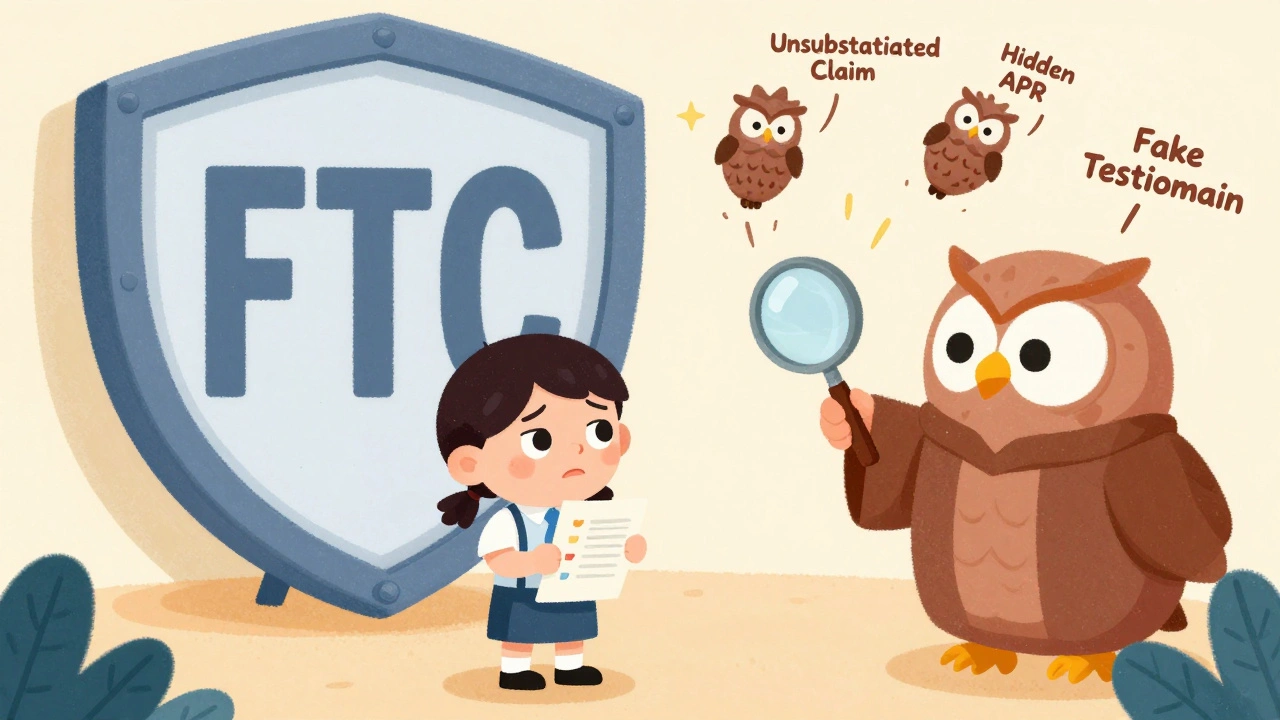
You’ve seen them: "Lose 20 pounds in 2 weeks!" "Our app doubles your savings!" "The #1 choice of financial advisors!" These sound like catchy slogans. But under the FTC’s Advertising and Marketing Basics guidelines, they’re legal landmines.Here’s the rule: every claim must be backed by evidence-and that evidence has to exist before you even launch the campaign. No "we’ll find data later." No "everyone says it." If you say your investment product returns 12% annually, you need historical performance data, audited by a third party, showing that result over a meaningful time period. If you say your credit card helps users save $500 a year, you need a study of real customers who actually achieved that.
The FTC doesn’t care if your claim sounds reasonable. If it’s not substantiated, it’s deceptive. In Q1 2025 alone, the FTC filed 89 cases against companies for unsubstantiated claims-up 31% from 2024. One fintech startup got hit with a $750,000 penalty for claiming their budgeting app "reduces debt by 60%" without proving it across a representative sample of users.
For financial products, the SEC’s Marketing Rule 206(4)-1 adds another layer. If you’re an advisor promoting performance, you must disclose:
- The exact time period covered
- Whether returns are gross or net (after fees)
- The benchmark used for comparison
- Any material risks involved
Violations? The average penalty is $147,500 per incident. And it’s not just big firms getting caught. A solo financial planner in Colorado was fined $92,000 in March 2025 for posting a client testimonial that omitted the fact the client had taken on high-risk leveraged positions.
APR Disclosures Are Not Suggestions-They’re Law
APR-Annual Percentage Rate-is one of the most regulated numbers in marketing. It’s not just about showing a number. It’s about showing it the right way, in the right place, at the right time.Under the Truth in Lending Act (Regulation Z), if you’re offering credit-whether it’s a loan, credit card, or buy-now-pay-later option-you must display the APR clearly and conspicuously within 48 hours of a consumer applying. That means:
- Font size: no smaller than 12-point
- Placement: above any additional fees or promotional language
- Clarity: no hidden terms, no "starting at" unless you’re also showing the rate for at least 80% of approved applicants
CFPB Bulletin 2024-03 made this even stricter. If you say "APR as low as 5.9%," you must also disclose what percentage of customers actually get that rate. In 2025, the CFPB fined a major online lender $1.1 million for showing a "5.9% APR" on their homepage while only 3% of applicants qualified for it.
And it’s not just digital. Even in print ads, direct mail, or TV commercials, the APR must be as prominent as the headline. A mortgage broker in Texas lost their license in June 2025 after running a billboard that said "Refinance Today! 3.5% APR!"-but the fine print in the ad’s footer had the actual APR at 7.2%.
Why does this matter? Because misleading APRs cost consumers billions. The Advertising Standards Authority reported a 53% spike in complaints about financial APR misrepresentations in 2025, with 31% of all financial ad violations tied to APRs.
Testimonials Are Traps If You Don’t Disclose
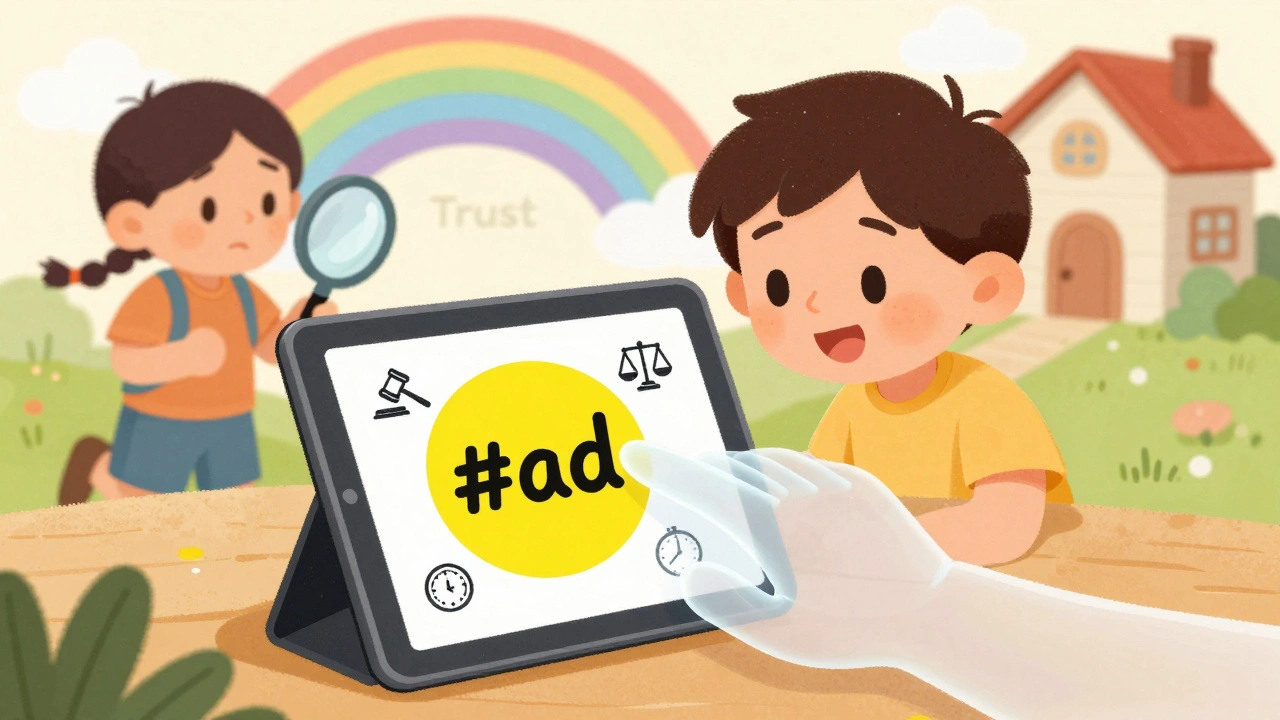
Customer testimonials are powerful. They build trust. But if you don’t disclose the right things, they become fraud.The FTC’s Endorsement Guides say: if someone is paid, given free products, or has any "material connection" to your brand, you must make that clear. No vague hashtags. No buried disclosures. It has to be upfront and unmistakable.
By 2025, 87% of influencer contracts include specific compliance language. The accepted language? "#ad," "Paid partnership," or "Sponsored by [Brand]." And it must appear in the first line of the post-on Instagram, TikTok, YouTube, or even in podcast audio. If it’s in the description or after the third paragraph? That’s a violation.
Even worse: fake testimonials. In 2025, the FTC cracked down hard on companies using AI-generated reviews or paid actors posing as customers. One health supplement brand was fined $2.3 million for using AI voices to create "customer testimonials" that never happened. The FTC now treats AI-generated endorsements the same as real ones-with full disclosure required.
And it’s not just influencers. If you post a review from a customer who got a discount in exchange for writing it, you must say so. If you use a testimonial from an employee? That’s a material connection too. Disclose it.
Here’s what happens when you get it right: a fintech startup in Austin added clear #ad labels to all influencer posts. Their conversion rate dropped 18% at first-but chargebacks fell by 41%, and customer satisfaction scores jumped 29%. Transparency builds real trust, not just clicks.
The New Compliance Reality: Automation Isn’t Optional
Trying to keep up with marketing compliance manually in 2025 is like trying to fill a bathtub with a spoon. Regulations change fast. Platforms update rules weekly. And one missed disclosure can cost more than your entire marketing budget.Leading companies now use automated compliance tools that scan every ad, email, landing page, and social post before it goes live. Platforms like OneTrust and ActiveProspect’s LeadConduit check for:
- Missing APR disclosures
- Undisclosed endorsements
- Unsubstantiated claims
- Opt-out links that don’t work
- Consent records that aren’t timestamped
These tools reduce human error by 76%. They also auto-update when laws change-like the April 2025 TCPA update requiring opt-outs to be processed within 10 days, down from 25. Most businesses didn’t even know the deadline moved until they got fined.
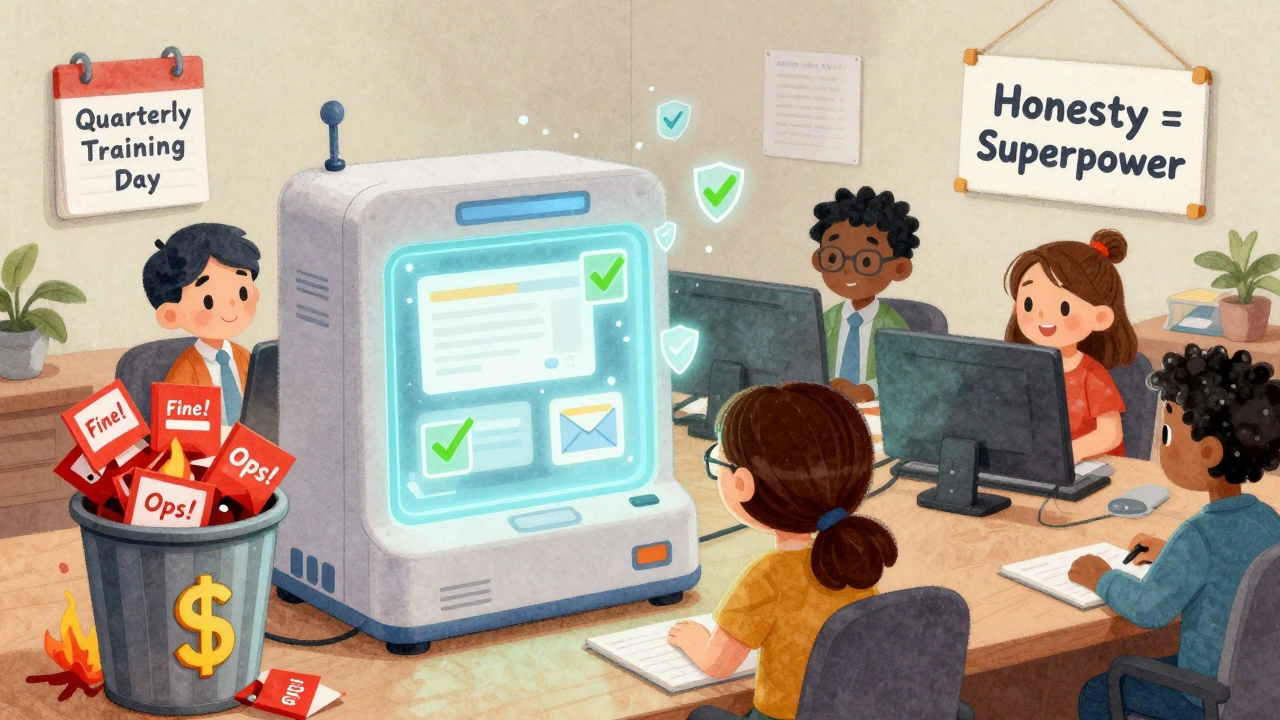
And it’s not just about tech. Companies that train their teams quarterly see 42% fewer violations. Training isn’t a box to check-it’s a live process. Your sales team needs to know what they can’t say. Your designers need to know where the APR must go. Your content team needs to know when a testimonial needs a #ad.
What Happens If You Ignore This?
The penalties aren’t theoretical. In May 2025, Meta paid a $1.2 billion fine under GDPR for improper data use in ad targeting. A small credit counseling firm in Florida was hit with $1.6 million in TCPA fines after sending 12,000 unsolicited texts without consent. A financial advisor in Chicago lost their license and was barred from the industry for using a fake client testimonial.But the real cost isn’t just fines. It’s reputation. Companies that comply see 27% higher customer retention and 34% stronger brand trust, according to ActiveProspect’s 2025 data. Non-compliant brands? Their Trustpilot scores average 3.1 out of 5. Compliant ones? 4.3.
Customers don’t just want good products. They want honest ones. They want to know they’re not being manipulated. When you follow the rules, you don’t just avoid fines-you build a brand people believe in.
Getting Started: Your 2025 Compliance Checklist
You don’t need a legal team to start. But you do need a plan. Here’s how to begin:- Review every ad, landing page, email, and social post. Highlight every claim, APR, and testimonial.
- For each claim: Do you have documented proof? If not, remove it or rewrite it.
- For every APR: Is it 12-point or larger? Is it above fees? Is it accurate for most customers?
- For every testimonial: Is there a material connection? If yes, add #ad or "Paid partnership" at the start.
- Install a consent management tool (like OneTrust) to track opt-ins and opt-outs.
- Train your team-once a quarter. Use real examples from recent enforcement cases.
- Keep records of all substantiation, consent, and disclosures for at least five years.
Compliance isn’t a cost center. It’s a competitive advantage. The brands that win in 2025 aren’t the ones with the flashiest ads. They’re the ones customers know they can trust.
What happens if I don’t disclose that a testimonial is paid?
The FTC can fine you up to $50,120 per violation. You’ll also face public enforcement actions, social media backlash, and loss of trust. In 2025, 87% of influencer contracts now require explicit disclosure language-ignoring it puts your entire campaign at risk.
Can I use "starting at" for APRs?
Yes-but only if at least 80% of approved applicants actually receive that rate. If only 10% qualify, you’re misleading consumers. The CFPB requires you to disclose the rate for the majority of applicants, not the lowest possible number.
Do I need to disclose if I’m using AI-generated testimonials?
Yes. The FTC updated its Endorsement Guides in July 2025 to treat AI-generated content the same as real human testimonials. If it looks like a customer spoke, but it was made by AI, you must disclose it clearly. Failure to do so is considered deceptive advertising.
How often do marketing compliance laws change?
Constantly. In 2025 alone, the TCPA reduced opt-out windows from 25 to 10 days, the SEC clarified testimonial rules for financial advisers, and the FTC cracked down on AI-generated reviews. Regulations are evolving faster than ever-automation tools that update in real time are now essential.
Is marketing compliance only for big companies?
No. Small businesses are targeted just as often. In fact, 68% of mid-sized companies struggle with compliance because they lack dedicated teams. But fines don’t care about your size. A single violation can cost more than your annual marketing budget. Compliance isn’t optional-it’s survival.
The notion that compliance is a "cost center" is not just naive-it’s economically illiterate. Regulatory adherence isn’t about avoiding fines; it’s about institutional integrity. The FTC’s enforcement surge isn’t arbitrary-it’s a direct response to the commodification of trust in digital markets. When a fintech startup substitutes substantiation with hype, they’re not just breaking rules-they’re eroding the epistemic foundation of consumer decision-making. The 41% drop in chargebacks post-disclosure? That’s not marketing-it’s restitution. And the fact that 87% of influencer contracts now mandate disclosure? That’s market self-correction in action. The real innovation isn’t in AI or automation-it’s in epistemic humility.
Automation tools like OneTrust aren’t luxuries-they’re the minimum viable epistemology for any entity engaging in persuasive communication. If you can’t audit your claims before deployment, you don’t deserve to advertise. The CFPB’s 2024-03 bulletin isn’t regulatory overreach-it’s the logical endpoint of a market that treated consumer cognition as a vulnerability to exploit. This isn’t compliance. It’s civilizational hygiene.
And let’s be clear: the "small business exemption" myth is a dangerous fantasy. The $92,000 fine on the Colorado planner? That’s not punishment-it’s a warning shot across the bow of every solopreneur who thinks "I’m just one person" makes them immune. The law doesn’t care about your overhead. It cares about your impact.
Disclosing AI-generated testimonials isn’t about transparency-it’s about ontological honesty. If a machine mimics human speech to induce financial behavior, and you don’t disclose it, you’re not advertising-you’re conducting a psychological experiment on unsuspecting subjects. That’s not capitalism. That’s cybernetic manipulation.
And the idea that "customers want honest products" is a tautology that obscures the deeper truth: customers want to be treated as rational agents, not data points. The 4.3 Trustpilot score for compliant brands? That’s the market pricing epistemic reliability. The alternative isn’t innovation-it’s entropy.
Compliance isn’t a checklist. It’s a covenant. And the only thing more dangerous than a non-compliant marketer is a marketer who thinks they’re "doing the right thing" without evidence. The FTC isn’t your enemy. The absence of rigor is.
Train your team quarterly? That’s a start. But if your training doesn’t include case law, statistical literacy, and rhetorical analysis, you’re just teaching compliance theater. Real compliance requires intellectual discipline. And that’s not something you can automate.
Five-year record retention? Good. But why stop there? Why not publish your substantiation publicly? The market rewards radical transparency. The ones who hide behind legal boilerplate? They’re already dead. They just haven’t filed for bankruptcy yet.
Oh wow, another corporate shill telling us how to be good little boys and girls so the government doesn’t slap our wrists. Let me guess-you also think we should all wear seatbelts and eat our vegetables while we’re at it.
You know what’s really illegal? The fact that the FTC has more power than Congress. You think a small business owner should spend $20k on software just to post a testimonial? Nah, they should just be allowed to say their product works-because it DOES. Who cares if you don’t have a 50-page audit? The customer knows. They can feel it.
And don’t get me started on this "#ad" nonsense. You think people are dumb enough to believe some influencer is doing this for free? Come on. We all know it’s paid. You don’t need a giant label. That’s like putting a sign on your car that says "This is a vehicle."
APR disclosures? Yeah right. Everyone knows "as low as" means it’s the best deal you’ll ever get. If you’re too stupid to read the fine print, maybe you shouldn’t be taking out loans. It’s called personal responsibility.
And AI testimonials? Are you kidding? I’ve seen real people say way worse things on Reddit than what some bot says. You want to ban AI? Next you’ll ban Photoshop. Then you’ll ban ads. Then you’ll ban capitalism.
Let me guess-you work for OneTrust and get a bonus every time a small business buys your software. Newsflash: most of us aren’t big banks. We’re just trying to make rent. Stop turning every marketing tactic into a federal crime.
And for the love of God, stop pretending this is about "trust." It’s about control. The regulators don’t want you to be honest-they want you to be powerless. And you’re handing them the keys.
Compliance isn’t a competitive advantage. It’s a tax on hustle. And the people who win aren’t the ones with the fancy tools-they’re the ones who still know how to talk to people without a lawyer in the room.
Bro, I just saw a TikTok ad for a credit card that said "APR as low as 3.9%" and the fine print was smaller than the emoji in the caption. I thought I was dreaming. Then I checked the CFPB’s site and-yep, they fined that exact company last week. $1.1M. For. A. TikTok. Ad.
Meanwhile, my cousin runs a small loan broker in Ohio and he’s still using a 2019 template with "guaranteed approval!" and no APR anywhere. He thinks "everyone knows what APR means." No, buddy. They don’t. And the FTC doesn’t care if you’re "just a small guy."
And the AI testimonials? I saw one last night. Some guy on YouTube was like "This app saved my marriage!" and his profile was created 3 days ago with 2 followers. The voice sounded like Siri on sedatives. I almost cried. Not because I’m emotional-because it’s so obviously fake and nobody calls it out.
My advice? If you’re not using automation, you’re just gambling. And the house always wins. I’ve seen too many local businesses get crushed by a single violation. One misspelled disclosure. One unmarked testimonial. One "as low as" that’s actually 1% of customers. Boom. $80k gone.
And yeah, #ad is annoying. But it’s better than losing your business. I’d rather have 10% fewer clicks and keep my house than be on the news for "deceptive marketing."
Training quarterly? Do it. Even if it’s just you watching a 10-minute CFPB video. Just don’t pretend you’re too busy. Your customers aren’t dumb. They’re just tired of being played.
Just wanted to say thank you for writing this. I’ve been helping small business owners in Australia transition to compliant marketing for the past year, and honestly? Most of them are terrified-not because they want to deceive, but because the rules feel impossible to navigate.
One guy I worked with, a local financial coach, thought he was being "authentic" by posting his client’s success story without a disclosure. He didn’t realize the client got a free month of coaching in exchange. He was crushed when he found out it was a violation. We fixed it together-added #ad, removed the exaggerated claim, and kept the real results. His engagement dropped at first… but his repeat clients? Doubled.
Compliance isn’t about fear. It’s about respect. When you disclose everything, you’re saying: "I see you as a person, not a number." And that’s the kind of trust no algorithm can fake.
Automation tools? Yeah, they’re expensive. But if you start with just one thing-like adding #ad to every influencer post-you’re already ahead of 90% of small businesses. No need to buy everything at once.
And for anyone thinking "this doesn’t apply to me"-it does. Your customers aren’t looking for the flashiest ad. They’re looking for someone they can believe in. And that’s not something you can buy. It’s something you earn.
One step. One disclosure. One honest moment. That’s how you build something that lasts.