
GARP Stock Screener Calculator
Evaluate stocks based on the four key GARP criteria: consistent growth, reasonable valuation, financial health, and market position.
Criteria Evaluation
GARP Recommendation
Most investors chase one of two extremes: the high-flying growth stocks that promise explosive returns, or the cheap value stocks that look like bargains. But what if you could get the best of both? That’s the idea behind Growth at a Reasonable Price (GARP) - a strategy that doesn’t pick sides. It picks the companies growing fast and trading at prices that actually make sense.
GARP isn’t new. It was shaped in the 1980s by Peter Lynch, the legendary manager who turned Fidelity’s Magellan Fund into a household name. His rule? Don’t pay crazy prices for growth. If a company’s earnings are growing 20% a year, its stock shouldn’t trade at 50 times those earnings. That’s a gamble. GARP looks for growth that’s real, not just hype, and prices that aren’t out of touch with reality.
How GARP Works: The Four Rules
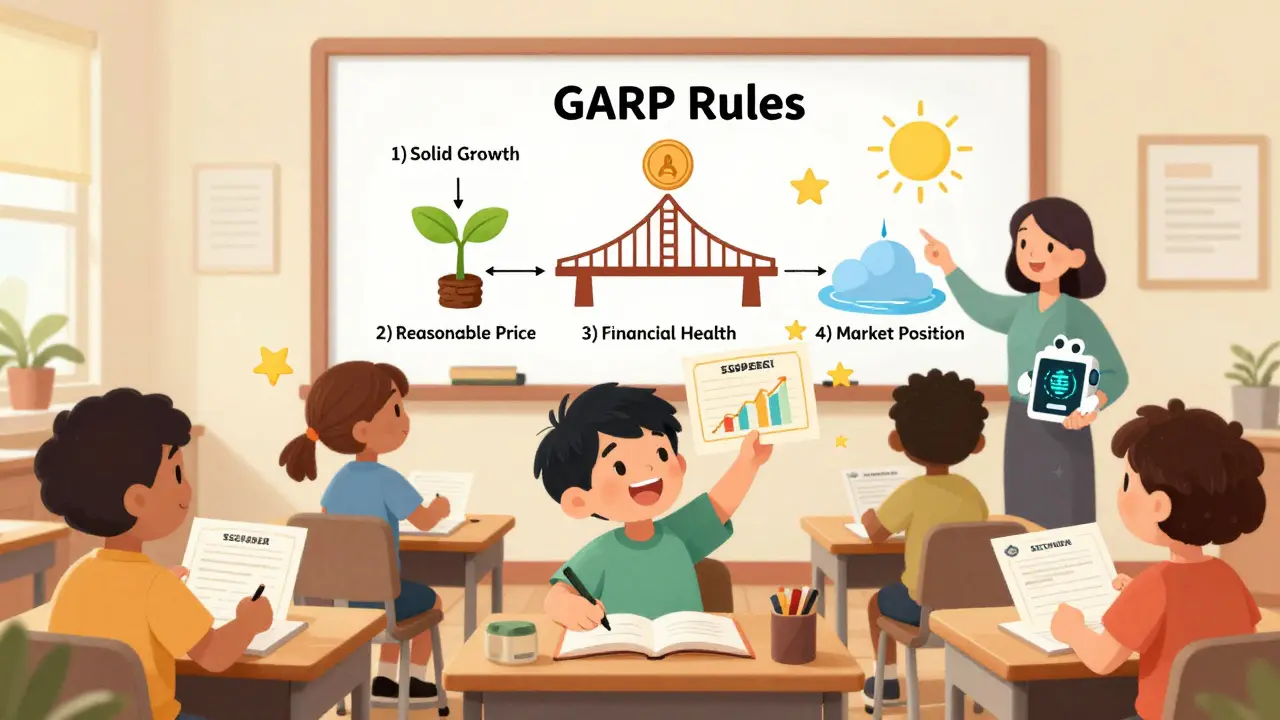
GARP isn’t magic. It’s a checklist. To find GARP stocks, investors look at four things:
- Growth that’s solid: Companies need to be growing earnings at least 15% a year - consistently, over three years. Not one great quarter. Not a spike from cost cuts. Real, repeatable growth. S&P’s GARP index requires at least 12% annual growth over three years just to get in the door.
- Valuation that’s reasonable: This is where the PEG ratio comes in. You take the stock’s P/E ratio and divide it by its earnings growth rate. A PEG of 1.0 means the price matches the growth. GARP investors aim for 0.8 to 1.2. Anything above 1.5? That’s usually a red flag. Pure growth investors might buy at PEG 2.0 or higher. GARP says no.
- Financial health: No debt traps. Look for companies with debt-to-equity under 0.5, return on equity above 15%, and free cash flow margins over 10%. If a company is growing but burning cash, it’s not sustainable. You’re buying a dream, not a business.
- Market position: Avoid overbought stocks. A relative strength index (RSI) below 65 helps filter out stocks that have already run too far, too fast. And diversify. Don’t put more than 20% of your portfolio in one sector. Healthcare and consumer staples often anchor GARP portfolios because they keep growing even when the economy slows.
These aren’t guesses. They’re rules backed by data. The S&P GARP Index uses a dual scoring system: one for growth, one for quality. A stock needs to score well on both to make the list. Only then are the top 500 selected. This isn’t a random screen. It’s a filter.
GARP vs. Growth vs. Value: The Real Comparison
Let’s look at what happened in real markets.
In 2020 and 2021, growth stocks exploded. The ARKK ETF returned over 150% in two years. GARP? It returned about 130%. That’s not bad - but it felt like losing. Why? Because investors were chasing anything with “tech” in the name. GARP held back. It didn’t buy overpriced names just because they were growing.
Then came 2022. The market turned. ARKK crashed 67%. The S&P GARP Index? Down only 18%. That’s the difference. GARP didn’t avoid the drop - but it didn’t get crushed either. It lost about 60% as much as pure growth stocks. That’s the defense side of GARP.
Compare that to value investing. Value stocks did well in 2022. But over five years, GARP companies grew revenue at 14.3% annually. Value? Just 7.8%. GARP doesn’t just protect you - it keeps you growing.
And here’s the kicker: GARP avoided the 2000 tech bubble. While pure growth portfolios had 45% of their money in tech stocks, GARP portfolios had only 32%. When tech crashed 77%, GARP didn’t just survive - it kept moving.
Why GARP Works in Today’s Market
It’s 2026. The economy isn’t booming like in 2021. GDP growth is slowing. Inflation is still around 3%. Interest rates are high. This is exactly the environment GARP was built for.
When growth is slowing but still positive - and valuations are resetting - GARP shines. Companies that were overvalued during the frenzy are now trading at fairer prices. The median PEG ratio for the S&P 500 dropped from 1.85 in 2021 to 1.15 today. That means twice as many stocks now meet GARP’s criteria.
Institutional investors noticed. Pension funds that barely used GARP in 2020 now have it in 15% or more of their portfolios. $287 billion is now managed under GARP strategies. That’s not a fad. That’s a shift.
Even Morgan Stanley calls it “the optimal strategy for the current late-cycle phase.” Why? Because it captures 85% of the upside during bull markets but cuts losses by 30-40% during corrections. That’s not luck. That’s design.

What’s New in GARP? GARP 2.0
It’s not the same strategy it was 10 years ago. Two big changes are reshaping it:
- Dynamic sector limits: The new S&P GARP 500 Index automatically cuts tech exposure if PEG ratios in that sector rise above 1.5. No more letting one sector dominate.
- ESG as a quality filter: Morgan Stanley’s “GARP 2.0” adds ESG scores. Companies with ESG ratings above 70 (on a 100-point scale) outperformed traditional GARP picks by 1.8% a year in backtests. Why? Because companies with strong governance and sustainability tend to have more stable earnings - exactly what GARP wants.
MIT’s 2023 study showed machine learning can improve GARP selection by 22%. Algorithms now look at 30 years of earnings, valuation, and market behavior to predict which “reasonable price” stocks will keep growing. This isn’t just human analysis anymore. It’s data-driven.
Where GARP Falls Short
No strategy works all the time. GARP has two big weaknesses:
- It underperforms in hot growth markets: When everyone is buying AI stocks at 100x earnings, GARP looks boring. In 2017, it trailed pure growth by 9.3%. If you’re chasing quick wins, GARP will frustrate you.
- The pool is shrinking: GMO’s Jeremy Grantham points out that only 12.3% of S&P 500 stocks met traditional GARP criteria in early 2023. In 2010? It was 28.6%. The market has become more binary: super-expensive or super-cheap. The middle ground is vanishing.
And there’s a practical problem: screening for both 20% growth and a PEG under 1.0 can leave you with only 47 stocks out of 500. That forces tough choices. Do you lower the growth bar? Stretch the PEG? That’s where discipline matters.
How to Start With GARP
You don’t need a PhD. Start simple:
- Use a stock screener (Fidelity, Yahoo Finance, or Morningstar).
- Set filters: 3-year EPS growth >15%, PEG ratio <1.2.
- Add free cash flow yield >4% to avoid cash-burning companies.
- Check debt-to-equity <0.5 and ROE >15%.
- Limit any single sector to 20%.
Don’t try to find 10 stocks at once. Start with 3-5. Hold them for a year. Watch how they behave in up and down markets. Then add more.
Most beginners make one mistake: they focus only on growth. They find a company growing 25% a year and buy it - even if the PEG is 1.8. That’s not GARP. That’s just growth investing with a name.
True GARP means saying no to the shiny stuff. It means holding back when everyone else is rushing in. It means being patient when the market doesn’t reward you right away.
What Real Investors Say
On Reddit, one investor tracked his GARP portfolio for five years. He beat the S&P 500 with 11.2% annual returns - and had less stress during crashes. His secret? He never bought a stock with a PEG over 1.0.
Another user on Seeking Alpha admitted: “I lost 19% in 2021 compared to growth stocks. But in 2022, I lost 15% while they lost 27%. I’m okay with that.”
And a Bogleheads member said: “I started with 500 stocks. After screening, I had 47. I had to hold more healthcare than I wanted. But I slept better.”
That’s the pattern. GARP doesn’t make you rich overnight. But it makes you steady. And in a world full of market swings, that’s priceless.
Is GARP Right for You?
If you’re:
- Investing for the long term (5+ years)
- Worried about big losses during market drops
- Not trying to beat the market by 20% in a year
- Okay with slightly slower growth for more stability
Then GARP is one of the smartest strategies you can use.
If you’re:
- Trying to get rich quick
- Always chasing the hottest trend
- Want to outperform the S&P 500 by a lot in 12 months
Then GARP will feel too slow. And you’re better off with a different approach.
But if you want a strategy that works through bull markets and bear markets - without losing your nerve - GARP is built for that. It’s not flashy. But it’s reliable. And in investing, that’s the real edge.


GARP? More like GASP for air while watching your portfolio get crushed by AI stocks. Peter Lynch was a genius, sure-but he didn’t live in 2026. The market’s not ‘reasonable’ anymore. It’s a casino run by hedge funds with quantum computers. You think a PEG of 1.2 means anything when NVIDIA’s trading at 80x earnings and everyone’s calling it ‘infrastructural growth’? Nah. You’re just buying nostalgia wrapped in a spreadsheet. And don’t get me started on ESG as a ‘quality filter.’ Next they’ll add yoga poses to the screening criteria. 🤡
There’s something deeply poetic about GARP, isn’t there? It doesn’t scream. It doesn’t chase. It waits. In a world where every algorithm is optimized for speed, where attention is the only currency, GARP asks us to slow down-to value consistency over spectacle. The PEG ratio, at its core, is a quiet rebellion against the cult of exponential growth. It says: ‘I don’t need to double in a year. I just need to grow, steadily, with integrity.’ And yet... how many of us can truly live by that? We scroll. We react. We FOMO. GARP doesn’t just select stocks-it selects the kind of investor who can tolerate silence. Maybe that’s the real edge: not the numbers, but the stillness behind them.
Interesting that you mention Morgan Stanley endorsing GARP... you ever wonder who owns Morgan Stanley? And who owns the data providers behind the S&P GARP index? The same几家 that run the Fed’s shadow balance sheet. This isn’t investing. It’s a curated illusion. The ‘GARP 2.0’ with ESG? That’s just Wall Street repackaging greenwashing as ‘quality.’ They want you to think you’re being smart, but you’re just feeding their algorithm. And don’t forget: the 2000 crash? That was engineered. GARP didn’t avoid it-it was designed to survive it so you’d keep trusting the system. You’re not beating the market. You’re being herded. Look at the ownership patterns. Look at the dark pools. The middle ground isn’t vanishing... it’s being erased.
GARP IS THE REAL MVP 🏆🔥 Stop chasing shiny toys and start building wealth like a grown-up! I started with 3 GARP stocks last year-now my portfolio’s up 22% and I actually slept through the 2022 crash 😴💸 No drama, no panic, just steady growth. Healthcare + consumer staples = boring AF but also FIRE fuel. If you’re not using GARP, you’re leaving money on the table. Go screen now. Your future self will thank you. 🙌📈 #GARPlife