
Emergency Fund Target Calculator
Calculate your emergency fund target using the proven hybrid approach from the article. Start with $1,000, then build to 3-6 months of essentials.
Your Target
Starter Fund: $1,000 (first step)
Target Fund:
Your Timeline:
How This Works
The hybrid approach combines both methods:
- Start with $1,000 to cover small emergencies (like car repairs or medical co-pays)
- Then build to 3-6 months of essential expenses
- Adjust based on your job stability, dependents, and income
How much should you really have saved for an emergency? That’s the question millions of Americans face every year. Some say save $1,000. Others say save six months’ worth of bills. Which one works better? The truth is, neither alone is enough. The smartest approach combines both - and here’s why.
Why Emergency Funds Matter
Life doesn’t wait for you to be ready. Your car breaks down. Your kid gets sick. Your hours get cut. In 2022, nearly 37% of U.S. households couldn’t cover a $400 emergency without borrowing money. That’s not just inconvenient - it’s dangerous. High-interest credit cards, payday loans, or dipping into retirement savings can set you back for years. An emergency fund isn’t a luxury. It’s your financial shock absorber.
The Fixed Amount Approach: Start Small, Stay Realistic
The idea of saving $1,000 as a first step isn’t arbitrary. It’s based on real data. According to Bankrate’s 2022 survey, 68% of Americans face unexpected expenses between $500 and $1,000 each year. That includes things like a broken appliance, a vet bill, or a last-minute car repair. A $1,000 buffer covers most of those without needing to touch your regular budget.
Financial advisors at Fidelity, Old National Bank, and NerdWallet all agree: start here. Especially if you’re carrying high-interest debt. Trying to save six months’ worth of expenses while juggling $20,000 in credit card debt? That’s a recipe for burnout. Instead, save $1,000, keep making minimum payments, and breathe. A 2022 study in the Journal of Financial Therapy found people with even $1,000 saved were 3.2 times less likely to feel overwhelmed during a crisis.
But here’s the catch: $1,000 doesn’t cover everything. The Consumer Financial Protection Bureau found that 41% of households with $1,000 still had to borrow money when faced with medical emergencies - which average $1,500+ for many families. If you’re single, have kids, or live in a high-cost area, $1,000 is just the beginning.
The Multiple-of-Expenses Method: Tailor It to Your Life
This is where most people get stuck. How do you figure out how much you need? Start by tracking your essential expenses - not your entire budget. That means rent or mortgage, utilities, groceries, basic transportation, minimum debt payments, and insurance. Skip the Netflix subscription, dining out, or gym membership. Those aren’t emergencies - they’re choices.
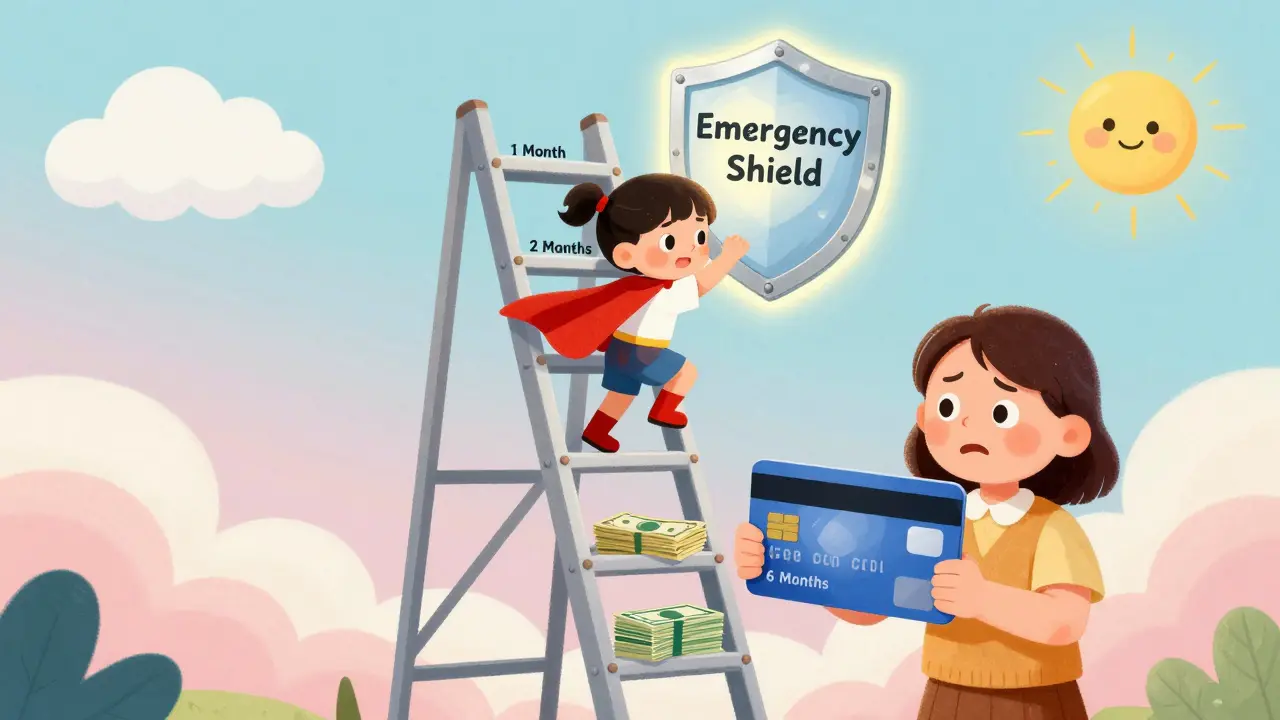
Now multiply that number. Most experts recommend 3 to 6 months. Vanguard breaks it down further: if you’re worried about a sudden cost (like a flat tire), half a month’s essentials is often enough. But if you’re scared of losing your job? Go for 6 months. The Bureau of Labor Statistics shows job loss can last over 15 weeks on average. That’s more than 3 months.
Some people need more. Freelancers and self-employed workers? The data says 8.3 months on average. Single parents? Aim for 6. Retirees on fixed income? 6 to 12 months. The St. Louis Federal Reserve’s 2025 guide says: “Multiply your essentials by 3” - and gives the example of $2,400/month in essentials = $7,200 target. That’s specific. That’s actionable.
Why the Hybrid Approach Wins
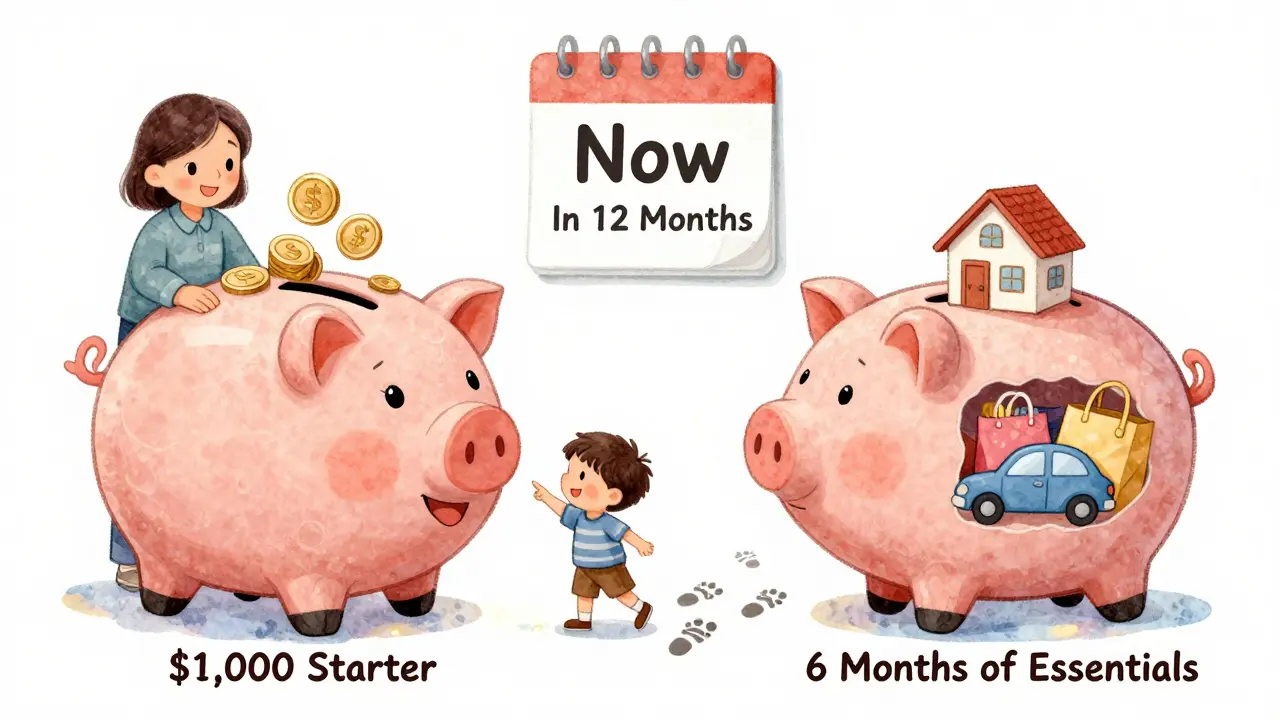
Here’s what the data doesn’t tell you: most people who succeed with emergency funds don’t start with $7,200. They start with $1,000 - and then build from there.
A 2023 Fidelity survey of 1,200 financial advisors found that 87% recommend this two-phase method. Why? Psychology. Saving $7,200 feels impossible. Saving $100 a month for 10 months? That’s doable. A Reddit user named u/SavingsSuccess shared: “Starting with $1k felt achievable. Once I hit that, scaling to 3 months ($12k) was easier.”
Meanwhile, those who skipped the $1,000 step and jumped straight to “six months” often gave up. NerdWallet analyzed 250,000 bank accounts and found that households using the hybrid method reached their goal 2.3 times faster than those trying to save the full amount upfront. Speed matters. Momentum matters. Small wins build confidence.
Real-World Scenarios: What Works for You?
Let’s say you’re a 30-year-old single professional earning $55,000 a year. Your essential monthly expenses are $2,200. That’s rent, groceries, gas, phone bill, minimum student loan payments. Your target? $6,600 (3 months).
Here’s how it plays out:
- Phase 1: Save $1,000 in 3 months ($333/month). You set up an automatic transfer from your checking to a high-yield savings account.
- Phase 2: Once $1,000 hits, you increase the transfer to $450/month. You’re now on track to hit $6,600 in 12 more months.
- Phase 3: When you hit $6,600, you pause. You don’t stop saving - you just stop treating it like a race. Now you’re building toward 6 months ($13,200) if your job feels unstable.
Now imagine you’re a freelance graphic designer. Your income swings from $1,800 one month to $4,200 the next. Your essentials? Still $2,200. But you need to cover slow months. Your target? 8 months - $17,600. You start with $1,000. Then you add $700/month until you hit $17,600. It takes longer. But you’re protected.
And if you’re on a tight budget? Maybe your essentials are $1,400. $1,000 is still your first step. Then you aim for 2 months - $2,800. That’s still better than nothing.
Where to Keep Your Emergency Fund
It’s not just how much you save - it’s where. A regular savings account earning 0.01% APY? You’re losing money to inflation. A certificate of deposit (CD)? If you need to pull money out early, you’ll pay a penalty. That defeats the whole purpose.
Use a high-yield savings account. In Q1 2025, the average APY was 4.25% (Bankrate). On $5,000, that’s $212 in interest per year - free money. Fidelity and Ally are two popular options with no fees, easy access, and mobile apps. Set up automatic transfers. Even $50 per paycheck adds up.
And don’t mix it with other goals. Don’t label it “vacation fund” or “new car fund.” Keep it separate. Name it “Emergency Cash” in your app. That mental separation makes you less likely to touch it.
What the Data Says About Who’s Winning
Here’s what the numbers reveal:
- Households earning $100,000+ have emergency funds covering 2.8 months of essentials.
- Households earning under $40,000? Only 0.9 months.
- Black and Hispanic households are more likely to have less than $250 saved - not because they don’t want to, but because systemic barriers make saving harder.
- Those who use the multiple-of-expenses method? 54% have fully funded funds.
- Those who only use fixed-amount? Only 31% do.
But here’s the kicker: the fixed-amount group got to their first goal 2.3 times faster. They started. They built momentum. They didn’t give up.
How to Start Today
You don’t need to be perfect. You just need to start.
- Calculate your essential monthly expenses. Add up rent, utilities, groceries, insurance, minimum debt payments. Ignore everything else.
- Set your first goal: $1,000. That’s your starter fund. No exceptions.
- Automate $50-$100 per paycheck. Even if it’s biweekly, $100 every two weeks = $2,600 a year. You’ll hit $1,000 in under 5 months.
- Once you hit $1,000, multiply your essentials by 3. That’s your new target.
- Keep automating. Increase your transfer to reach that number in 12-24 months.
- Review every 6 months. Did your rent go up? Did you get a raise? Adjust your target.
And if you’re overwhelmed? Start with $500. Then $750. Then $1,000. Progress beats perfection.
Final Thought: It’s Not About the Number - It’s About the Habit
The Consumer Financial Protection Bureau found that people who set a specific numeric goal - like “save $1,000” - were 63% more likely to succeed than those who just said “save more.” Numbers work. They give you a finish line.
Emergency funds aren’t about being rich. They’re about being prepared. Whether you’re a single mom, a freelancer, or a salaried worker - you deserve peace of mind. Start small. Build smart. And never stop.
Is $1,000 enough for an emergency fund?
$1,000 is a good starter goal, especially if you’re just beginning to save. It covers common small emergencies like car repairs or minor medical bills. But it’s not enough for everyone. If you have dependents, high medical costs, or unstable income, you’ll need more. Think of $1,000 as your first checkpoint - not your final destination.
Should I save 3 months or 6 months of expenses?
It depends on your risk level. If you have a stable job, health insurance, and no dependents, 3 months is often enough. If you’re self-employed, a single parent, or work in a volatile industry, aim for 6 months. Vanguard’s data shows 6 months protects against 97% of job loss scenarios. The key is matching your fund to your real-world risks - not a generic rule.
What if I have debt? Should I still save?
Yes - but start small. Save $500-$1,000 while making minimum payments on your debt. This prevents you from going further into debt when an emergency hits. NerdWallet’s 2023 survey found 73% of advisors recommend this strategy. Once you have your starter fund, focus on paying down high-interest debt - then rebuild your fund to 3-6 months.
Can I use a CD or money market account for my emergency fund?
Avoid CDs. They penalize early withdrawals, which defeats the purpose of an emergency fund. Money market accounts are okay if they offer easy access and no penalties. But the best option is a high-yield savings account - it earns more interest, has no withdrawal fees, and lets you access your money instantly online or via app.
How often should I review my emergency fund?
Review it every 6 months. Life changes - rent goes up, you get a raise, you have a baby, or your hours get cut. If your essential expenses change by 10% or more, adjust your target. Don’t wait until you’re in crisis to realize your fund is outdated.
Do I need to save for emergencies if I have good insurance?
Yes. Insurance doesn’t cover everything. You still have deductibles, copays, uncovered treatments, and non-medical emergencies like car breakdowns or appliance failures. Even with great insurance, unexpected costs pile up. An emergency fund covers what insurance leaves out.
Emergency funds aren’t about being rich. They’re about being ready. And readiness starts with one step - not a giant leap.

Look, I get it - $1,000 is the new ‘just start somewhere’ mantra. But let’s be real: if you’re living paycheck to paycheck and your car breaks down, $1,000 isn’t a buffer - it’s a Band-Aid on a hemorrhage. I’ve seen people hit that $1k goal, pat themselves on the back, and then get hit with a $1,800 vet bill and end up with a 24% APR loan. You don’t build financial security by celebrating tiny wins. You build it by planning for the worst-case scenario - not the ‘maybe if I’m lucky’ scenario.
And don’t get me started on ‘multiplying essentials.’ What’s ‘essential’? If you’re in Texas and your AC dies in July? That’s essential. If you’re in Minnesota and your furnace dies in January? That’s essential. But if you’re in a city with public transit and no kids? Maybe you don’t need a car payment in there. One-size-fits-all advice is lazy. Tailor it or fail.
I really appreciate how this post breaks it down - not just with numbers, but with humanity. I’ve helped a few friends through this exact process, and what I’ve learned is that the emotional weight of saving matters just as much as the math. That $1,000 milestone? It’s not about the money. It’s about proving to yourself that you can do something hard. That first win gives you the courage to keep going.
One of my clients, a single mom working two jobs, started with $50 a month. She cried when she hit $1,000. Not because it was a lot - but because she’d done it without quitting. That’s the real power of the hybrid approach. It’s not about being rich. It’s about becoming someone who believes they deserve safety.
And yeah, if you’re freelancing or in a volatile industry - go bigger. But don’t shame anyone for starting small. Progress isn’t linear. And sometimes, the bravest thing you can do is just show up - even if it’s with $20.
While the article’s structure is logically sound, its empirical claims are dangerously oversimplified. For instance, the assertion that ‘68% of Americans face unexpected expenses between $500 and $1,000’ - sourced from Bankrate’s 2022 survey - is misleading without context. The survey’s margin of error was ±3.5%, and the definition of ‘unexpected expense’ included things like ‘gifts’ and ‘holiday spending.’
Furthermore, the claim that ‘people with $1,000 saved were 3.2 times less likely to feel overwhelmed’ is drawn from a non-peer-reviewed study in the Journal of Financial Therapy - a journal with an impact factor of 0.8. This is not robust evidence; it’s anecdotal correlation dressed as causation.
Additionally, the recommendation to use a ‘high-yield savings account’ at 4.25% APY ignores inflation-adjusted returns. With CPI at 3.8%, real yield is negligible. A true financial safeguard requires asset allocation - not just a savings account. The advice here is well-intentioned, but dangerously shallow.
Oh, so now we’re giving out gold stars for saving $1,000? Congrats, you didn’t go broke when your toaster died. Big. Freaking. Deal.
Meanwhile, in the real world - where people actually have to survive - $1,000 is what you scrape together after your car gets totaled and your insurance only pays $500. You think you’re ‘prepared’? You’re one flat tire away from begging on Reddit for a loan. And don’t even get me started on ‘multiplying essentials.’ What’s essential? Your Netflix? Your gym membership? Your $8 latte habit? No. What’s essential is not being homeless when you lose your job.
If you’re making under $40k and think 3 months is enough, you’re delusional. The median rent in the U.S. is $1,800. That’s $5,400 right there. Add utilities, food, phone, car insurance - you’re at $7k minimum. So why are we celebrating $1k like it’s a victory lap? This isn’t empowerment. It’s financial gaslighting.
And don’t even mention ‘high-yield savings.’ I’ve seen accounts with 4.25% APY that charge $5 for an ACH transfer. That’s not banking - that’s a scam with a logo.
There is, perhaps, a deeper truth here - one that transcends the arithmetic of emergency funds: the human need for control in a world that is, fundamentally, uncontrollable.
We construct numbers - $1,000, 3 months, 6 months - not because they are objectively sufficient, but because they offer the illusion of order. A number is a boundary. A line in the sand. A promise to ourselves: ‘If I reach this, I will be safe.’
But safety is not a quantity. It is a state of mind. And yet - paradoxically - it is precisely this quantification that allows us to begin. Without a target, we float. Without a number, we are lost in the fog of ‘someday.’
The hybrid approach, then, is not merely pragmatic - it is profoundly psychological. It acknowledges our fear - and then gently, deliberately, gives us a ladder. Step one: $1,000. Step two: a reflection on what ‘essential’ truly means. Step three: the quiet courage to keep going, even when the goal expands.
Perhaps the most radical thing we can do - in a culture obsessed with speed and outcomes - is to honor the slow accumulation of dignity. Not the fund itself. But the person becoming, one dollar at a time.
And if that person, in their quiet persistence, finds peace - then, perhaps, they have already arrived.